Before OpenAI first released to community (Around 2018-2020), everything had to be done manually. You had to read guidelines and documentation for new tech, find tools to understand customer behavior, and design based on common sense while hoping it would match user interests.
Then the AI arrived, and many AI solutions were found. At first, you were hesitant, fearing you might lose your job.
As AI companies started releasing updated versions, you realized AI is more exciting than you expected. You even asked your husband, your go-to tech guy, for help.
You installed Claude and realized you could now approach any tech stack available on the Internet. You don’t even need to read documentation anymore; Claude reads it for you.
All of your questions were finally answered:
- create a bunch of landing pages at the same time.
- you have huge amount of contents, and now they have a place
- optimize pagespeed was a nightmare, but not anymore
- You could finally create a small database, and are planning to actually handle it
- …and the list goes on.
Yes, you were excited, but at the same time, exhausted. AI is like a horse, while you are still walking on your own two feet.
Riding a horse is fun and fulfilling, but is it smart? An AI tool is a portal connecting you to millions of solutions on the Internet. While AI cannot define your most important questions, it knows more than you do - or at least it knows the sources and people with better knowledge.
But we are not going to talk about how to use AI; let’s talk about your mental health. Since installing Claude, you’ve started chatting with it non-stop: during your 9-to-5, during your night time, and even when you wake up in the middle of the night with an idea. The scary part is that you don’t feel tired at all; at least until your body sends a disturbing alarm.
Why don’t you feel tired?
It’s around 6 PM, and you’ve just arrived home. You are cooking dinner, but all you can think about is wrapping it up, washing the dishes quickly, and getting your baby to sleep so you can go back to your workstation. You know this isn’t healthy, but for some weird reason, you don’t feel tired, even though you’ve been up since 5 AM without a nap.
What’s happening to your body?
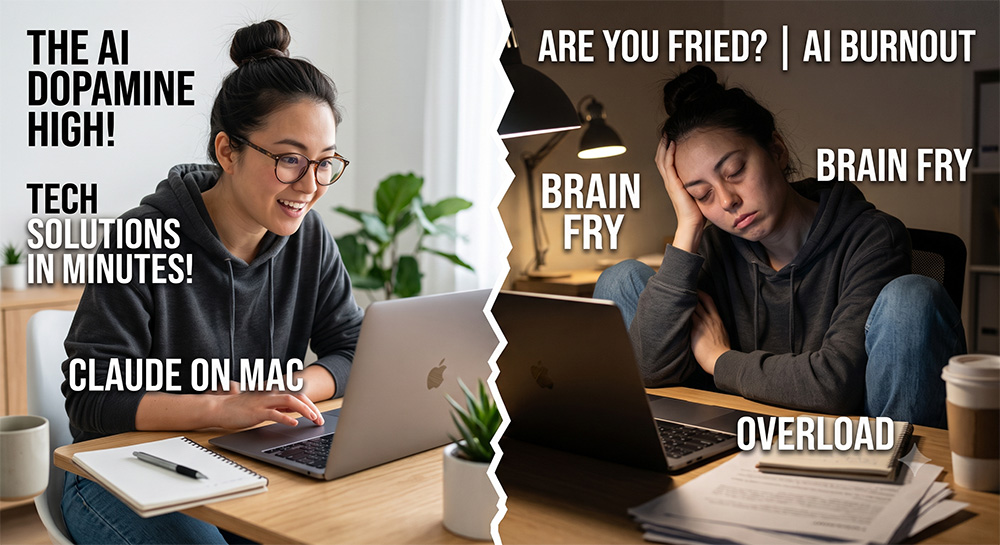
When you are on a run of solving one problem after another, your brain is flooded with dopamine. The dopamine makes you feel happy and excited, causing you to “forget” that you are tired.
This intense, sustained focus naturally depletes your levels of serotonin and melatonin; the two hormones responsible for relaxation and resting stability. They are the ones that signal to your body that it’s time to rest.
If you keep your system overdosed with dopamine for too long, once the hormone finally fades, you are left with a physical crash and a pounding headache.
Takeaway: AI is meant to elevate your life, not consume your health.
Signs of AI brain fry telling you to stop
Think of “AI brain fry” like this: instead of doing the manual labor, you are now the manager of a huge number of parallel tasks. You aren’t exhausted from typing code, but your brain is cloudy from constantly reviewing, fixing, and approving.
Attention
Do not overdose yourself with coffee if you’re exhausted because of AI brain fry. Pouring caffeine into an already fried brain is like burning out an engine that’s already smoking.
Coffee won’t cure your decision fatigue or help you think straight; caffeine just covers up your tiredness with jitters while pushing you closer to a total crash. Your brain doesn’t need another espresso, it needs you to walk away.
Because dopamine makes you always feel excited, you must consciously ask yourself: “When should I be feeling tired?”
- You start to feel slightly hungry. That stomach hunger might fade if you have a drink, but remember that your body needs foods.
- Your eyes start to feel dry or itchy. This is a direct consequence of staring at the screen for too long.
- “I’m just going to do this one commit and then I’ll go.” You’ve repeated this for at least two tabs now. New tabs are open in front of you, and you feel attached to them regardless of your physical state. That’s not logic or commitment; that’s the hormone driver talking.
- You feel constantly annoyed - with your family, your boss, or even when you need to attend to basic needs.
- You stop understanding what the AI is saying, even after re-writing a prompt multiple times. This is a clear sign of mental exhaustion.
Tips to relax
To calm down, try these quick, physical ways to disconnect from AI:
- Off screen for at least 5 Minutes: Leave your macbook and iphone. Walk around, have water and just do not think of anything. You can use pomodoro timer for this rest session
- Maintain relationships with loved ones: Aim for a short chat about non-work topics for at least 15 minutes every day.
- Do things by hand: if you’re working at home, this is the perfect time to wash a few dishes, make a hot cup of tea, or pet your cat.
- Take a slow breathing break: Breathe in through your nose for 4 seconds, hold it for 7, and exhale slowly through your mouth for 8 seconds.
- Have at least 1 hour of working on your own thoughts everyday. Stop leaving Claude open in a background tab where it can distract you.
- Set an “AI Bedtime”: No AI after 9 PM or at least 1-2 hours before bed. Use the evening to watch movies or relax completely with your loved ones.
What happens if you choose not to rest
- Sloppy mistakes: Errors become inevitable when your brain is fried and foggy.
- Physical damage, with alarming symptoms like hair loss, skin issues, or difficulty in controlling your weight.
- AI hangovers: Much like consuming alcohol, you will wake up the next morning with a headache, a foggy mind, and zero energy to start the day.
- Eventually, your body will run out of “happy hormones.” What started as a fun, exciting tool will leave you feeling constantly tired, anxious, and sick of work.