
33, a ridiculous age…
You cannot do scrap work like in your 20s. You aren’t as healthy as you were at 22…
If you had the strength, you should have started your own business 5 years ago…
But you are stuck here with a 4-year-old job… You love this job, honestly, but you know your boss is tired as well. You don’t know how long he can endure this business. Costs are going up, and there are fewer and fewer clients every day…
All your freelance gigs have expired. They have simply shrunk down, or the companies have closed.
You knew a guy from your husband’s circle, born in 1988, now already 38. He is going to be out of a job this October.
In your 20s, you heard that your 30s would be the glory era of a lifetime. But when you’re actually living it, it’s not quite what they said. Every day, you’re walking on a tightrope like Philippe Petit, the man who walked between the Twin Towers in NY back in 1974. One false step, and you plummet straight into Hades.
In your 20s, you heard that your 30s would be the glory era of a lifetime. But when you’re actually living it, it’s not quite what they said. Every day, you’re walking on a tightrope like Philippe Petit, the man who walked between the Twin Towers in NY back in 1974. One false step, and you plummet straight into Hades.

But you are still luckier than others…
Because you were born in ’93, and your age matches the artificial intelligence era.
You are not too old to adapt, or too young to lack experience.
There is still room for you, you just need to try harder, for a little longer.
Workflows could do amazing things; they could do your repetitive tasks entirely, leaving you with plenty of time to think about your business.
Let’s talk about creating a workflow for job hunting. A simple topic, but I know lots of you need this…
“Who are you?”
Employers can read your profile off your identification card. They do not need you to re-state it in your interview. Keep your general introduction down to 2, or a maximum of 3 sentences.
It’s not what you’ve done, it’s what you’ve achieved. This is a common mistake in lots of CVs.
Instead of:
I was the person-in-charge of all the company’s digital marketing activities back in 2023
Let’s write:
Organic Search Impact: Reached a milestone of 723,000 lifetime organic views, contributing 35% of the website’s total traffic.
Bosses care about achievement and your process for reaching it, not your previous scope of work without evidence.
Most important of all, your CV must portray your workplace spirit and career goal. That’s where employers find you suitable/ unsuitable for the job.
Prompt your needs
To answer the question of how to find a job you like, you need to be very specific with your prompts. In your AI terminal, let’s write:
- What is your target role? For example: Digital Marketing Specialist, Data Analyst…
- What is your target working mode? For example: Full time, Part time, Remote, Freelance…
- If full-time jobs, what are your preferred locations?
- Expected salary
- Your industry choices (You can let AI read your CV and make suggestions for you, or you can input these yourself)
- Input your CV (can be a link or a file, it doesn’t matter).
Let AI suggest a workflow
After prompting, AI normally returns:
- Company
- Title
- Industry
- Job Type
- Language
- Salary Ask
- Status
- Source (job search sites)
- Location
- URL
- Notes
Ask AI to generate at least 3 batches, each batch containing 5 available jobs, so you can have an overview of what the labor market needs at that moment.
Then, ask AI to export to Google Sheets for your next actions. You will normally have 3 choices:
- Return and edit your CV
- Re-prompt
- Customize your message based on company profiles and start sending emails.
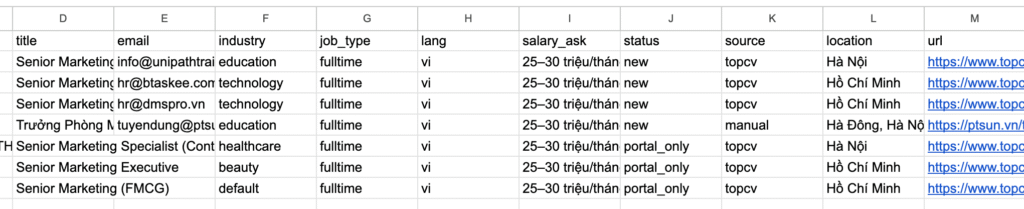
Do not rely solely on LinkedIn
There are other job search websites as well; sometimes LinkedIn is a dead end. Try sites like Indeed or Glassdoor, or check company career pages directly to find fewer competitors and better response rates.
Below are the most popular job search sites at the moment:
- Global Job Aggregators: Indeed, Glassdoor, ZipRecruiter, Google for Jobs
- Remote & Flexible Boards: FlexJobs, Remote.co, We Work Remotely, Working Nomads
- Tech & Startup Platforms: Wellfound (formerly AngelList Talent), Built In, Dice, HackerNews (Ask HN: Who is hiring?)
- Freelance & Contract Platforms: Upwork, Fiverr, Toptal, Freelancer
- Niche & Industry-Specific Sites: Behance / Dribbble (Design & Creative), GitHub Jobs / Stack Overflow (Engineering), HigherEdJobs (Education)
- Direct Channels: Target Company Career Pages, Local Alumni Networks, Industry Slack & Discord Communities
Craft your email on a personal level
Generic mass emails go straight to the trash bin. HR managers can spot a copy-pasted template at first glance. If you want a response, your email needs to feel like a one-on-one conversation, not a broadcast.
Here is how to leverage AI to personalize every single application without losing your voice:
- Feed the context: Give the AI both your tailored CV and the target company’s job description, along with recent news or achievements about the company.
- Match the tone: Ask AI to analyze the company’s culture (from their website or social updates) and adapt your writing style - whether that’s corporate, energetic, or direct.
- The 3-Part Email Structure:
- The Hook: Skip the formal “I am writing to apply for…”. Start with a genuine observation about their product, a recent milestone, or a specific problem they are trying to solve.
- The Proof: Connect 1-2 of your major achievements directly to their current needs. Show them what you can bring to the table on Day 1.
- The Call to Action: Keep it low-friction. Instead of asking for a 30-minute interview, ask a simple question to open a conversation.
Example Prompt to Use:
“Based on my CV and this Job Description from [Company Name], write a concise 150-word cold email to the Hiring Manager. Highlight my achievement in [Specific Skill/Metric] and explain how it solves their current challenge in [Mention a pain point from the job ad]. Keep the tone warm, professional, and authentic.”
But remember, you need to edit your replies, no matter how good the content created by AI is. Automation gets your foot in the door, but personal relevance is what gets you hired. Treat each email as the beginning of a working relationship, not just a job request.